News and Announcements / News and Announcements

Remarks by Dr. Rajiv J. Shah at “A Call to Action for Renewed International Cooperation"

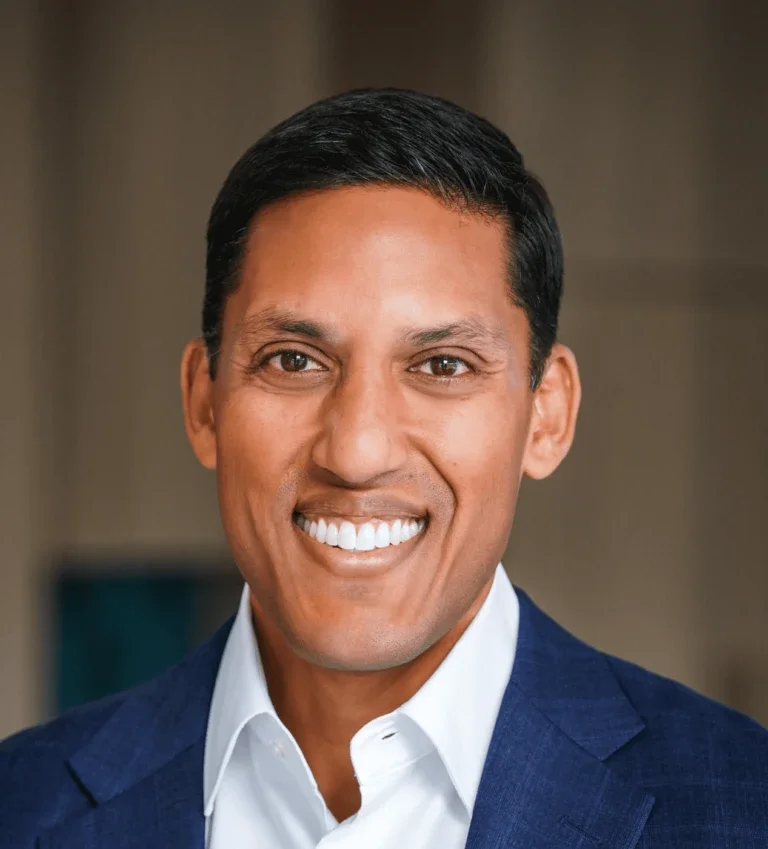
Dr. Rajiv J. Shah, President of The Rockefeller Foundation, delivers remarks on renewed international cooperation.

As delivered on Monday, September 21, 2026, at The Rockefeller Foundation, New York, NY.

Good morning. How are you?

Welcome to the beginning of UNGA week. I know that we all share enthusiasm for the chance to come together here. Before we jump in, I just want to offer a few words of thanks.

First, I want to thank Prime Minister Gordon Brown. Gordon, without your persistent leadership, we would not be here today for this particular effort. I will hold on some of the announcements so you can make them during your remarks. But I have to say when Gordon had this idea a bit more than a year ago, a number of us were—as with all of his ideas—eager to get behind it and help, but also questioned whether in the environment we live in, we can make progress on the theme this morning of reimagining global cooperation based on the basic principle of universal human dignity. Gordon, you’ve really done that. So thank you for your leadership.

President Santos, another amazing Rockefeller Foundation board member. That, more than his Nobel Peace Prize, is what he considers his greatest achievement. President Santos, we’re thrilled you’re with us.

I’d also like to thank the former president of Costa Rica, Laura Chinchilla, thank you for being here. And the former Prime Minister of Sweden, Stefan Löfven, we’re thrilled that you’re with us here as well.

Now, why are we here? We’re here because 80 years ago, a brand-new United Nations held its first-ever General Assembly in London. The world was rebuilding from World War II. Sixty million people had died. Millions more had lost their homes or were starving. And entire cities like Berlin, Tokyo, and Prague, of course, were in ruins.

Officials found a space for that first UNGA in Methodist Central Hall, Westminster, which had survived the war undamaged. As delegates from 51 nations traveled to London, the massive church was outfitted with tables, translation booths, the UN’s olive branch logo and even a bar, to the delight of the delegates, but dismay of some of the congregation members. We do not have a bar here this morning.

But perhaps the most surprising thing they installed were television cameras. The inaugural session of UNGA was the first international conference to be televised around the world. And that’s because those leaders knew what we’ve learned the hard way in recent years: that the public trusts global cooperation only when it acts accountably and delivers results.

Today we’re all here to recommit to that basic mission. That human dignity is universal, that that simple idea which is founded in the Declaration of Independence of the United States is also the underlying principle of the United Nations. It is ultimately the reason we all come to New York this week for this grand event we call UNGA.

And as a principle, it lives its form today in a much more pessimistic world. We have to be honest with ourselves. The United States cut $38 billion in needed humanitarian and foreign assistance. That same amount, $38 billion, is what we’ve already spent on the war in Iran. We know the consequence of those cuts, not just by the United States but also in Europe where total official development assistance has been cut by almost 24%—23.1%. The Rockefeller Foundation has funded studies that have shown that that will yield about 9.4 million lives lost over the course of the next five years. Boston University has highlighted how that has already cost this planet the lives of 700,000 vulnerable children, women, and families, family members.

So the question is: Can we reimagine coming together in the spirit of the first UNGA, and coming together around the principle of universal human dignity, in a modern, accountable, and results-oriented forum today? Like I said, I will not go through the results of a poll [inaudible] across 34 nations, 36,000 poll respondents. I think you’ll find the results to be both deeply encouraging and optimistic and also challenging. Encouraging and optimistic because people in their hearts and in their minds understand that if we respect the principle of human dignity and universal human dignity, we are safer and more secure on this planet. And challenging because people demand results and accountability in a world where they just don’t trust leaders making decisions behind closed doors anymore.

With that, it’s my honor to introduce our keynote speaker, a visionary global leader who has spent years rallying the world to reject division and come together on behalf of humanity. Please welcome my friend and colleague Gordon Brown.
As delivered on Monday, September 21, 2026, at The Rockefeller Foundation, New York, NY.

Good morning. How are you?

Welcome to the beginning of UNGA week. I know that we all share enthusiasm for the chance to come together here. Before we jump in, I just want to offer a few words of thanks.

First, I want to thank Prime Minister Gordon Brown. Gordon, without your persistent leadership, we would not be here today for this particular effort. I will hold on some of the announcements so you can make them during your remarks. But I have to say when Gordon had this idea a bit more than a year ago, a number of us were — as with all of his ideas — eager to get behind it and help, but also questioned whether in the environment we live in, we can make progress on the theme this morning of reimagining global cooperation based on the basic principle of universal human dignity. Gordon, you’ve really done that. So thank you for your leadership.

President Santos, another amazing Rockefeller Foundation board member. That, more than his Nobel Peace Prize, is what he considers his greatest achievement. President Santos, we’re thrilled you’re with us.

I’d also like to thank the former president of Costa Rica, Laura Chinchilla, thank you for being here. And the former Prime Minister of Sweden, Stefan Löfven, we’re thrilled that you’re with us here as well.

Now, why are we here? We’re here because 80 years ago, a brand-new United Nations held its first-ever General Assembly in London. The world was rebuilding from World War II. Sixty million people had died. Millions more had lost their homes or were starving. And entire cities like Berlin, Tokyo, and Prague, of course, were in ruins.

Officials found a space for that first UNGA in Methodist Central Hall, Westminster, which had survived the war undamaged. As delegates from 51 nations traveled to London, the massive church was outfitted with tables, translation booths, the UN’s olive branch logo and even a bar, to the delight of the delegates, but dismay of some of the congregation members. We do not have a bar here this morning.

But perhaps the most surprising thing they installed were television cameras. The inaugural session of UNGA was the first international conference to be televised around the world. And that’s because those leaders knew what we’ve learned the hard way in recent years: that the public trusts global cooperation only when it acts accountably and delivers results.

Today we’re all here to recommit to that basic mission. That human dignity is universal, that that simple idea which is founded in the Declaration of Independence of the United States is also the underlying principle of the United Nations. It is ultimately the reason we all come to New York this week for this grand event we call UNGA.

And as a principle, it lives its form today in a much more pessimistic world. We have to be honest with ourselves. The United States cut $38 billion in needed humanitarian and foreign assistance. That same amount, $38 billion, is what we’ve already spent on the war in Iran. We know the consequence of those cuts, not just by the United States but also in Europe where total official development assistance has been cut by almost 24%—23.1%. The Rockefeller Foundation has funded studies that have shown that that will yield about 9.4 million lives lost over the course of the next five years. Boston University has highlighted how that has already cost this planet the lives of 700,000 vulnerable children, women, and families, family members.

So the question is: Can we reimagine coming together in the spirit of the first UNGA, and coming together around the principle of universal human dignity, in a modern, accountable, and results-oriented forum today? Like I said, I will not go through the results of a poll [inaudible] across 34 nations, 36,000 poll respondents. I think you’ll find the results to be both deeply encouraging and optimistic and also challenging. Encouraging and optimistic because people in their hearts and in their minds understand that if we respect the principle of human dignity and universal human dignity, we are safer and more secure on this planet. And challenging because people demand results and accountability in a world where they just don’t trust leaders making decisions behind closed doors anymore.

With that, it’s my honor to introduce our keynote speaker, a visionary global leader who has spent years rallying the world to reject division and come together on behalf of humanity. Please welcome my friend and colleague Gordon Brown.