Everyone wants access to good jobs, education, affordable energy, quality healthcare, nutritious food, and clean air and water. How do we make that a reality? With development goals that include skills-building, strategy, and guidance — not just aid. Expanding on the purpose of development to create positive change requires consensus, shared purpose, and clear goals at a global level.
Adopted in 2015, the U.N. Sustainable Development Goals (SDGs) represent a paradigm shift in global development. They are an articulation of what is required to ensure that people can live with dignity, agency and opportunity. Unlike the Millennium Development Goals (MDGs) that came before them, the SDGs take a holistic approach, incorporating environmental sustainability, economic development, and social progress — instead of focusing mainly on basic human needs. Rather than centering on aid delivery, they emphasize growth and structural change. And crucially, the SDGs apply to all participating nations, underscoring that global development creates a better future for everyone.
Some of the seeds for the SDGs were planted at a 2013 Bellagio Center convening titled Towards aPost-2015 Development Paradigm. Hosted by the Korea Development Institute (KDI) and Canada’s Centre for International Governance Innovation, the gathering brought together leaders and experts from around the world to identify core tenets that could guide international development efforts through 2030. Building on the 2010 Seoul Development Consensus for Shared Growth and the 2012 Rio+20 Conference on Sustainable Development and shaped by a multiyear, multinational engagement effort, many of the core ideas in the “Bellagio Goals” became defining features of the SDGs.
As we approach the end of the SDGs, it’s important to reflect on what they have accomplished. They are audacious and aspirational and likely will not be completed by 2030. Yet they still represent a global win, driving unprecedented international collaboration on pressing issues like climate change and reshaping how the world approaches development. The lessons they have taught us about what works — and what does not — will be crucial as our world defines its post-2030 priorities.
We spoke to Dr. Wonhyuk Lim, a professor at the KDI School of Public Policy and Management, who played an instrumental role in the creation of the Seoul Development Consensus and in the formation of the Bellagio Goals. He discussed the need for a holistic view of global development, what it took to build alignment and adoption, and what the lessons of the SDGs hold for the next development agenda.
If we view development as being solely about basic human needs, we wind up stuck in the paradigm of charity and dependence.
Dr. Wonhyuk LimProfessor, KDI School of Public Policy and Management
How did you become involved in shaping the post-2015 development agenda?
In 2010, Korea hosted the G20 Summit in Seoul, and KDI was heavily involved in drafting the development consensus. The MDGs were due to conclude in 2015, and I wanted the next development agenda to go beyond just fulfilling basic human needs and promote a more dynamic, sustainable approach.
The MDGs mostly focused on poverty reduction and basic needs, only targeting low-income countries, and I thought this was too narrow a concept. Nobel Laureate Amartya Sen talked about development as the freedom to realize your potential. It’s a holistic concept that’s applicable to everyone, whether they’re rich or poor. If we view development as being solely about basic human needs for lower-income countries, we wind up stuck in the paradigm of charity and dependence.
The Seoul Development Consensus, which came out of the summit, embraced these approaches. It centered on expanding industry and trade skills, developing infrastructure, financial inclusion, and building the social safety net. It emphasized growth and structural transformation as driving the development process, rather than aid transfer and aid delivery.
How did the 2013 convening at the Bellagio Center come about?
During the G20 Summit process in 2010, I had a good working relationship with a couple of researchers at the Centre for International Governance Innovation, particularly Barry Carin. He and I saw eye to eye on this approach to global development, so we co-organized a multiyear, international collaborative project between our organizations to help define the post-2015 agenda.
Over the next two years, we held regional workshops discussing what should succeed the MDGs. We wanted to get international organizations and experts involved and keep the “goal/target/indicator” format of the MDGs, and we knew any consensus would need buy-in from large and emerging nations like China, India, Brazil, South Africa, and others. So, we held workshops in Paris, Beijing, Pretoria, Rio de Janeiro, and Mumbai, and then presented draft findings in Washington, DC, and New York.
This process was very effective. In February 2013, it culminated in The Rockefeller Foundation’s Bellagio Center convening, where we invited representatives from international institutions, researchers, scholars, practitioners, presenters from the regional workshops, and other experts to work out the details.

How did you reach consensus at the convening around the so-called “Bellagio Goals?”
The groundwork we did at the regional level helped ensure that none of the obstacles were too serious. There was pushback from some in the aid sector who were reluctant to change directions from what had been set in the MDGs. But by then, many scholars and practitioners saw that focusing on North-South aid delivery wasn’t going to work, given the resurgence of countries like China and India and the limitations of depending on aid to generate development impact.
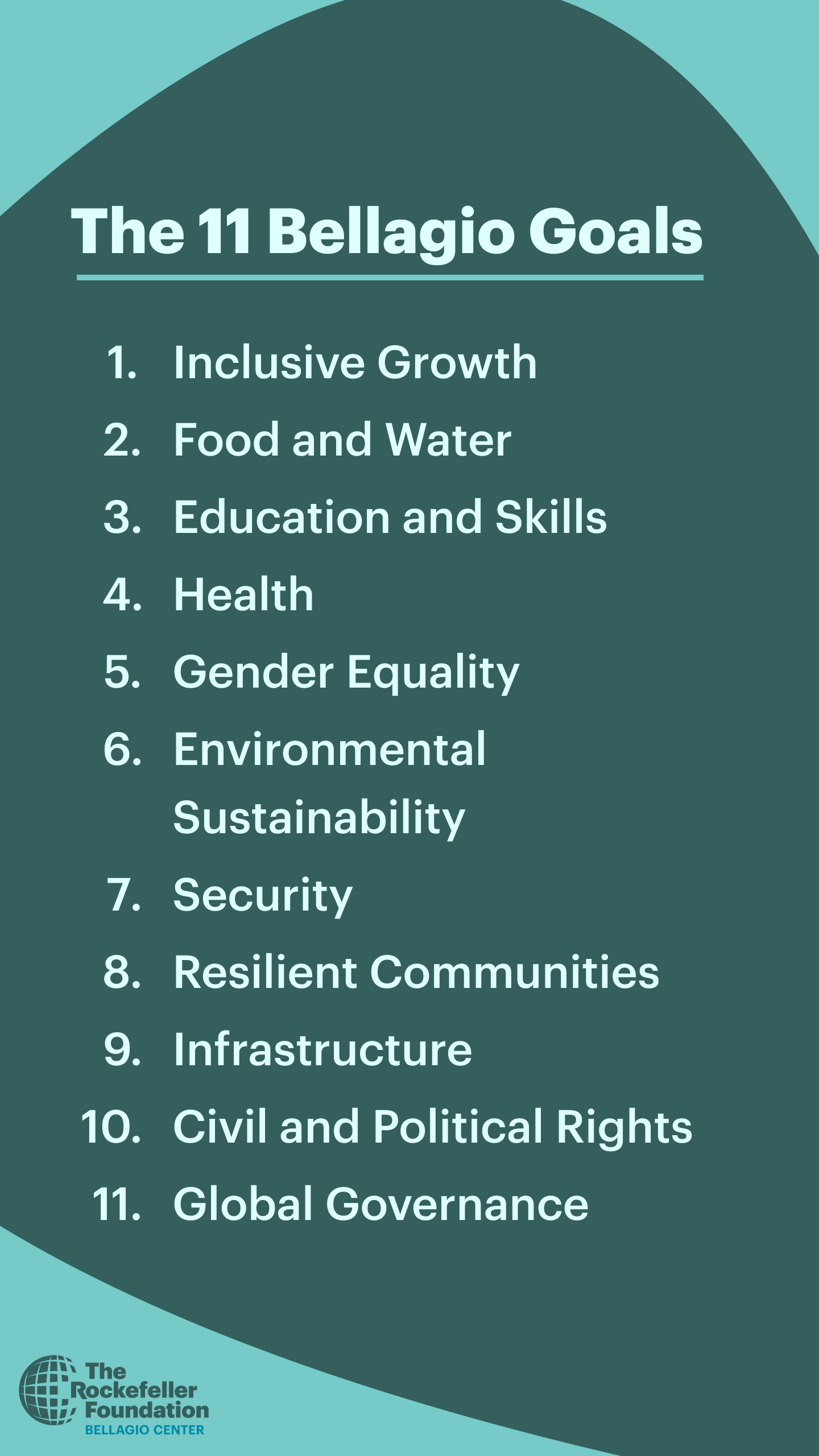
Overall, it was relatively straightforward to build alignment due to the emerging consensus that the agenda needed to have convergence between development and the environment. There was overarching agreement on the idea of sustainable development — that it should have environmental, economic, and social dimensions. Those ideas were at the heart of the Bellagio Goals, which focused on inclusive growth, food and water, education and skills, health, gender equality, environmental sustainability, security, resilient communities, infrastructure, civil and political rights, and global governance.
In May 2013, the U.N. High-Level Panel of Eminent Persons on the Post-2015 Agenda released a report to provide recommendations on the development agenda that would follow the MDGs. One of the members was the minister of foreign affairs and trade for the Republic of Korea, and I was brought on in an advisory role. The panel’s final report pretty much reflected the arguments and ideas in the Bellagio Goals, and you can see many of those same concepts went on to be part of the SDGs.
What lessons do the Sustainable Development Goals hold for the post-2030 agenda?
The most important impact has been bringing the economic, social, and environmental dimensions of sustainable development together and emphasizing growth and structural change as driving the development process, rather than aid transfer and delivery. Those things were major changes, and they shouldn’t be dismissed.
When it comes to the goals themselves, the midterm assessment of the SDGs shows that most aren’t close to being achievable by 2030. But the post-2030 agenda can still build on the lessons from those results. It’s clear there should be more emphasis on industry and trade, skills, innovation, and social cohesion as driving impact. If you look at the historical trajectories of nations that became advanced industrial countries — including the United States, Japan, Korea, and others — they focused on productivity-enhancing activities, rather than spreading resources around. They emphasized creating physical and institutional infrastructure to unify the market and generate dynamic efficiency through competition and interaction. They invested in education, people, and R&D. And they emphasized the role of finance to drive real growth, rather than asset bubbles.
The post-2030 agenda needs to include an honest discussion about strategy, instead of setting the goals and leaving countries to figure out the strategies and how to finance them. There’s a quote I heard from the statisticians involved in the Bellagio Center convening: “You don’t fatten a pig by weighing it.” It’s important to see where you are, to track progress, and so on. But at the end of the day, you have to figure out how to fatten the pig, and that involves strategy.
The Bellagio Goals were created in a time of upheaval, in the wake of the 2008 global financial crisis. As we forge the next global development agenda in another time of great change, Lim sees reason for hope. “Global issues have become so important, and the distribution of power is becoming even more so,” he said. “In a multipolar world, even if one country or another decides not to contribute to a solution, there can still be enough push to make progress.”
Learn More:
- Read the 2010 Seoul Development Consensus for Shared Growth.
- Explore the 11 Bellagio Goals in KDI and CIGI’s report Post-2015 Development Agenda: Goals, Targets & Indicators.
The opinions expressed in this article are those of the author. The Rockefeller Foundation is not responsible for and does not endorse its content.