Bellagio Center / Bellagio Breakthroughs / Bellagio Breakthroughs

Revolución diamantina (Glitter Revolution): Gabriela Ortiz on Speaking Out Through Music

In 2019, thousands of Mexico City women took to the streets in protest after two teenage girls reported being sexually assaulted by members of the city’s police force. Calling for equal rights, government action, and an end to gender violence, their movement became known as the “Revolución diamantina” (Glitter Revolution) after protesters showered the city’s security chief with pink glitter.
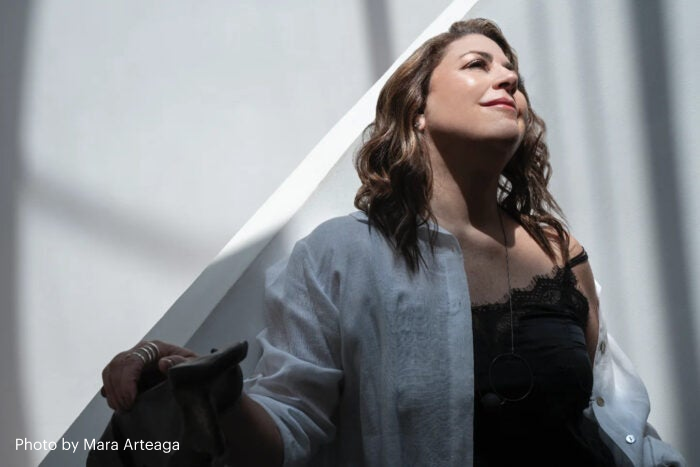
Gabriela Ortiz, a woman with dark, wavy hair, stands at the top of a stairwell in front of a white wall, smiling and looking up. Photo by Mara Arteaga.

Award-winning Mexican composer and Bellagio Center Resident Gabriela Ortiz was one of those gripped by the protests. Ortiz — whose work has addressed a wide range of issues, from colonialism to climate change — found inspiration in the bravery of the demonstrators and their use of “diamantina rosa” (pink glitter) to turn art into a weapon for peace.

Ortiz partnered with her brother, visual artist Rubén Ortiz-Torres, and Pulitzer Prize–winning Mexican author Cristina Rivera Garza to create a ballet that tells the story of the Glitter Revolution, the violence that spawned it, and the women who brought it to life. She used her 2023 Bellagio Center residency to refine and deepen the music and structure of the work in preparation for its debut. In November 2023, Revolución diamantina premiered at the Walt Disney Concert Hall in Los Angeles, quickly earning worldwide recognition. In 2025, the recording won three Grammy Awards, including Best Contemporary Classical Composition.

We spoke to Ortiz about the power of art to address social issues, the creation of Revolución diamantina, and the response the piece has sparked around the world.

  • This doesn’t just belong to women. It belongs to everyone. If we want to make change, it has to come from all of us.
    Gabriela Ortiz
    Composer, Revolución diamantina

How do you use art to address issues that are important to you?

When I was a student, people saw Europe as determining the “rules” for classical music. One of those rules was that music had to be abstract. When I tried to address real issues, people said: “You can’t do that. Bringing in politics makes your music propaganda.” But when I write music, I use everything that I have in me — my views, my emotions, my present, my context.

It is important that we confront the violence used against women. Eleven women are killed every day in Mexico. And it’s not just in Mexico. The violence happens everywhere, every day. The way I speak up about this is through my music.

What drew you to create music about the 2019 protests in Mexico City?

It started after the L.A. Philharmonic did a performance of my violin concerto. They asked me, “What would you like to write for us?” Without even thinking, I said, “A ballet.” I wanted to be ambitious, to write a substantial orchestral piece.

I called up my brother, Rubén Ortiz-Torres, who is a visual artist and a full-time professor at UCSD. He was very aware of the 2019 protest, and as we talked about it, I immediately realized that this subject could be at the center of the ballet. Watching and reading about the demonstration was very emotionally powerful. I had these images in my mind of dancers as the protesters, throwing glitter on the stage.

As we developed the idea, my friend Juan Villoro suggested I work with Cristina Rivera Garza. She wrote an incredibly powerful book, “Liliana’s Invincible Summer: A Sister’s Search for Justice,” about the femicide of her sister, who was killed by her boyfriend. So I asked Cristina to come on as a dramaturg and create a libretto.

How did the themes and ideas of Revolución diamantina come together?

LasTesis, a Chilean feminist movement, also became part of the story. Their performance art deals with violence against women and has been replicated all over the world. It includes powerful words based on the writing of Rita Segato, a feminist anthropologist from Argentina.

Another theme explores the femicides that continue to happen between Ciudad Juarez and El Paso, Texas. Most of the young women who have been killed or disappeared work in maquiladoras or maquilas — factories where they assemble TVs and radios and other products. In the ballet, there’s a moment where the singers keep saying, “maquila,” as a representation of those women.

In 2020, there was another major protest, one of the biggest ever to happen in Mexico City. I couldn’t be there, so I tweeted, “If you are going to this protest, send me audio.” I received thousands of recordings, and those became part of the ballet. I used phrases directly from the protest, such as “With clothes or without clothes, you don’t have the right to touch my body,” “We want to be free,” and “The rapist is you.”

My Bellagio Center residency gave me space to think about this work and find solutions in the months before the ballet’s premiere. Being able to see the lake and be surrounded by nature, to read and work and be exposed to the ideas of the people in my cohort, it was all enriching as I completed the final stages of the process.

What has it been like seeing the piece performed?

The first performance of Revolución diamantina was by the L.A. Philharmonic, conducted by Gustavo Dudamel. This was just the music. I wanted to produce a good score that could stand by itself. It’s like The Rite of Spring by Stravinsky: You don’t need to see the choreography to appreciate what he did. Earlier this year, the L.A. Philharmonic performed my music again, this time as a ballet with the Brazilian dance company Grupo Corpo.

In July, we staged it at the Palacio de Bellas Artes in Mexico City. It was performed by Centro de Producción de Danza Contemporánea and choreographed by Claudia Lavista, Lola Lince, and Melva Olivas. This performance was so important because the whole story stems from Mexico. It brought a very different group of people out — people from the dance world, feminist writers, not just the normal people who go to a classical music concert. Many, many of the audience members told me they had been a part of the protests in 2019 and 2020. So many people were crying. It was all quite moving.

Now, there are performances of Revolución diamantina coming up around the world. Productions are scheduled in Brazil, Colombia, the Czech Republic, and Serbia. The U.K. Youth Orchestra is even putting on a production next year. The person there said, “These performers are 16 and 17 years old, and it’s important for them to understand the ideas behind this ballet.”

What stands out to you in terms of the response this piece has received?

The whole experience has been so strong and rich and complicated. It’s like Mexico City itself. Everything at the same time.

I’m still trying to digest it all. Never in my wildest dreams did I think that I would win three Grammys with this piece. It makes me think that something is changing. They’re giving a prize to a piece that has such strong content. And as a Mexican composer, I come from a musical tradition that has not always been fully represented in the traditional classical music world. But Revolución diamantina has been a media tsunami — one I’m still trying to navigate.

Revolución diamantina moved the audience in a very distinct way. I’ve received very good reactions from listeners before, of course, but there’s something particularly special about this piece, especially for women.

And it’s still going forward. After my friend Lorena Maza saw the world premiere — she’s a stage director who did The Last Dream of Frida and Diego with the L.A. Opera — she told me, “You need to do an opera. It has to be your next project.”

I reached out to Cristina Rivera Garza, and she said, “Let’s work together on it.” That’s where we are right now. The opera will be a new collaboration inspired by her book about the death of her sister. I’ll compose the music, and she is writing the libretto.

Ortiz is gratified by the way that Revolución diamantina has been embraced by people of so many different backgrounds and experiences in countries all over the world. “It shows that this doesn’t just belong to women. It belongs to everyone,” she said. “If we want to make change, it has to come from all of us.”

Learn More:

The opinions expressed in this article are those of the author. The Rockefeller Foundation is not responsible for and does not endorse its content.